
Free GPR Datasets for Concrete Inspection
Real-world radargrams for rebar detection, void mapping and thickness measurement on reinforced concrete
Ground Penetrating Radar has become the reference non-destructive method for reinforced concrete inspection. Its ability to detect embedded rebar, map internal defects, and measure structural elements without core drilling makes it essential for civil engineering diagnostics, quality control, and structural assessment.
GPRbase provides free GPR datasets acquired on real reinforced concrete structures: slabs, walls, columns, beams, and bridge decks. Each dataset contains raw radargrams in native GSSI format (.DZT), ready for interpretation with GPRviewer or your preferred GPR software. All data is distributed under Creative Commons BY-NC-SA 4.0, so you can freely use them for training, academic research, software validation, or algorithm development.
Whether you're learning rebar picking, evaluating a new GPR software, or building training material for your team, these real-world datasets give you the variety and complexity that synthetic data cannot match. Every radargram captures the authentic noise, coupling effects, and geometric distortions of on-site acquisitions.
Concrete GPR datasets
Free raw radargrams — download and explore — 21 datasets available
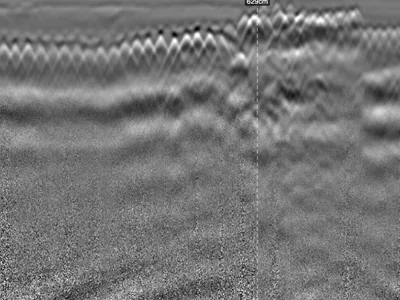
Reinforced Concrete Accessibility Ramp: Three Frequencies, Two 2.5 GHz Antennas and Cross-Polarisation on the Same Profile
Reinforced concrete accessibility ramp surveyed along the same profile with three configurations: dual-frequency UtilityScan DF at 300/800 M…
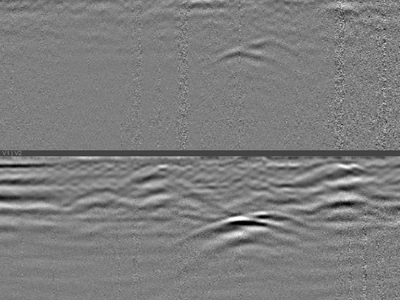
Buried Utilities Beneath a Reinforced Concrete Slab: Detection Through Dense Reinforcement
A 4.50 m profile recorded with a GSSI UtilityScan DF dual-frequency 300/800 MHz antenna, on a reinforced concrete slab, perpendicular to the…
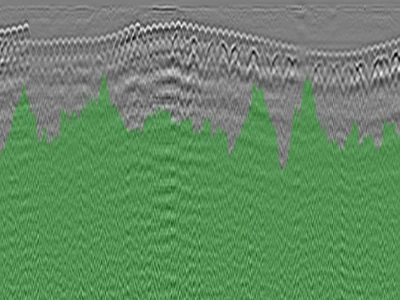
GPR Survey of a Car Park Raft Slab Showing Multiple Defects and Forms of Distress
Profile recorded on the raft slab of a car park showing multiple forms of distress, with a GSSI NX15 antenna at 1.5 GHz. One file. Two phen…
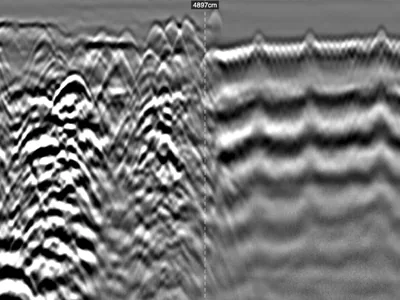
Industrial Slab GPR Survey: Heterogeneous Reinforcement and Subgrade, Inputs for Bearing Capacity Assessment
Profile recorded on a factory floor with a GSSI UtilityScan DF dual-frequency 300/800 MHz antenna, ahead of new works. No records exist, no …
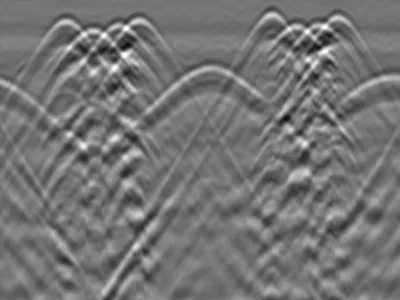
Circular Reinforced Concrete Column : Perimeter Scan and Rebar Repositioning in Section View
Circular reinforced concrete column, 20 cm radius, surveyed by horizontal scanning around its full perimeter with a GSSI FLEX NX dual-channe…
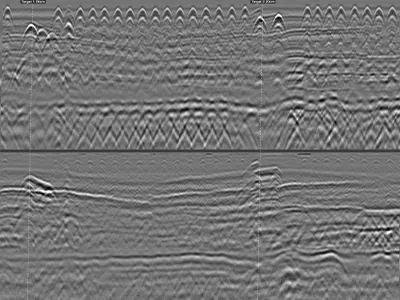
Reinforced Concrete Beam: Continuous Longitudinal GPR Survey with Markers at Two Columns
Reinforced concrete beam, 35 cm thick, surveyed continuously over more than 9 metres with a GSSI FLEX NX antenna. Two user markers were plac…
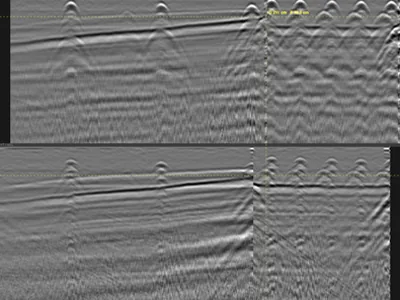
T-Shaped Retaining Wall: Variable Thickness from a Vertical then Horizontal GPR Profile
T-shaped retaining wall surveyed with a GSSI FLEX NX antenna. A single profile, run first vertically up the stem, then horizontally, without…
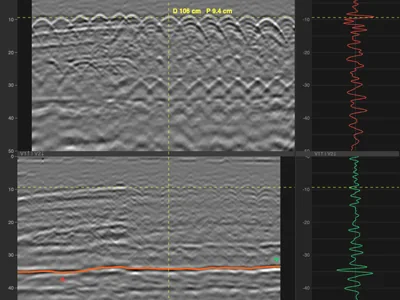
Reinforced Concrete Column — Cross-Polarisation to Image the Far Face and Calibrate Permittivity
Reinforced concrete column surveyed on all four faces, labelled A, B, C and D, by vertical scanning from bottom to top along the centre line…
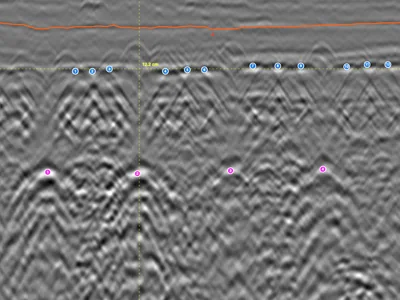
Beam-and-Block Floor — Cross-Polarisation on Inline and Cross-Line Channels
Radargram recorded on a beam-and-block floor with a GSSI FLEX NX stepped-frequency antenna, dual channel: one antenna oriented inline, the o…
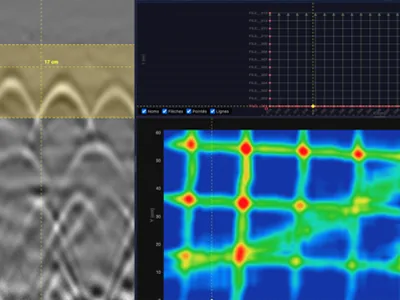
3D Grid on Reinforced Concrete — Rebar Mesh and Diagonal Electrical Cable
3D grid acquired on a reinforced concrete slab with a GSSI StructureScan XT 2.7 GHz antenna: 38 profiles over a 1.2 × 0.6 m area. The horizo…
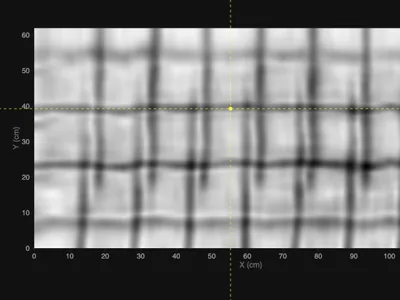
3D Grid on Reinforced Concrete — Welded Mesh Overlap for Rebar Picking
3D grid acquired on a reinforced concrete slab with a GSSI NX25 stepped-frequency antenna, over a 1.2 × 0.6 m area. The slab contains two la…
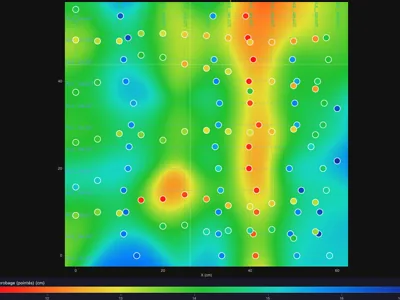
3D Grid on Densely Reinforced Concrete — Rebar Picking and C-Scan Tuning
3D grid acquired on a densely reinforced concrete structure with a GSSI StructureScan XT 2.7 GHz antenna, over a 60 × 60 cm area. The high b…
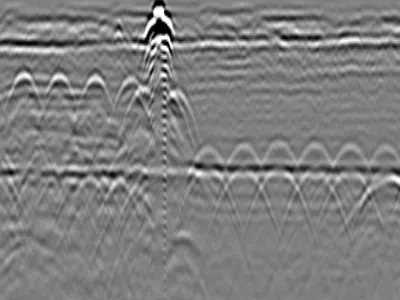
Reinforced Concrete Slab with Expansion Joint
GPR dataset containing 7 files collected on a reinforced concrete slab using a GSSI FLEX NX structure-scanning radar. The data clearly show …
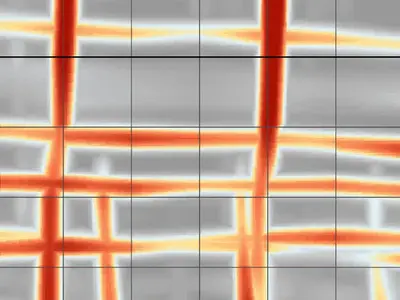
3D concrete scanning over a slab-access ramp interface
60 x 60 cm 3D grid (10 cm spacing). Starting point at bottom left (0,0) and profiles from left to right, then from bottom to top. Try to rec…
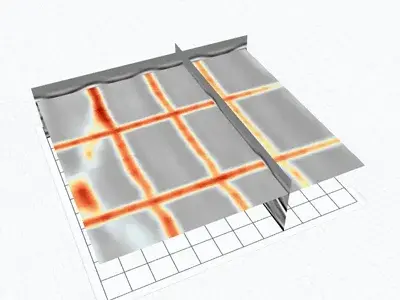
Two layers of rebars in a reinforced concrete structure (3D grid)
26 profiles (60 x 60cm grid), 5cm spacing. Ideal dataset for practicing 3D processing with GPRviewer, and easier to see the best possible re…
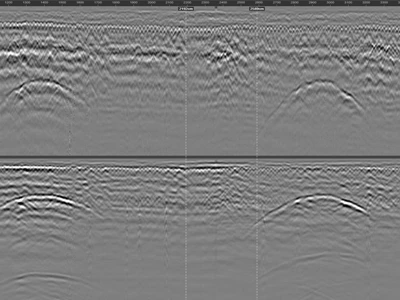
Thickness detection above three masonry bridge arches
Ground-penetrating radar measurements recorded with UtilityScan DF 300/800 MHz from the roadway…
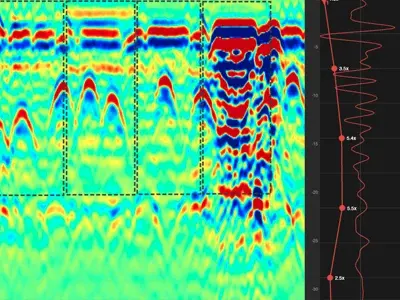
Voids in a concrete block wall
FLEX NX file, dual antenna (inline & cross-line), created on a concrete block wall with gaps (no concrete) at the end of the profile. Test t…
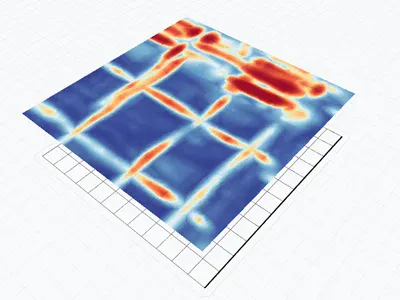
3D Grid Concrete bloc wall with voids
3D grid 60x60 cm created with the FLEX NX radar, 3D mode (26 profiles per antenna) Spacing : 5 cm Origin (0,0) : bottom-left…
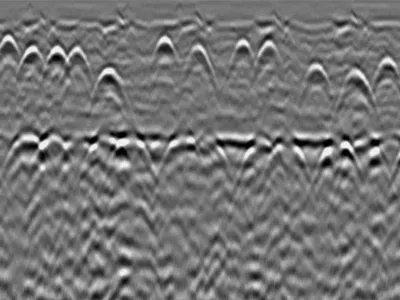
FLEX, NX25 and NX15 reference lines (MDSLab)
Three radar profiles were created on the same line, one of our reference lines in the MDSLab in Aix-en-Provence. Compare the measurements of…
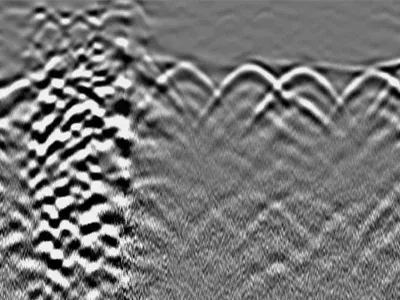
Double layer of reinforcement and structural change (1 profile)
One radargram. Two identifiable steel layers, the second being more difficult to discern. A change in structure is also visible before 50 cm…
GPR for reinforced concrete
High-frequency electromagnetic waves reflect on rebar and material interfaces, producing characteristic hyperbolic signatures on the radargram. GPR is non-destructive, gives immediate results, and involves no radiation — making it deployable on active construction sites without safety perimeters. It complements traditional methods like core drilling and ultrasound testing by providing continuous coverage rather than point measurements.
Rebar detection
Each rebar produces a hyperbolic reflection whose apex marks the bar location. Modern GPR software (including GPRviewer) can automatically pick these hyperbolas to determine rebar position, cover depth (with 2-3% accuracy in typical conditions), spacing, and orientation. This is critical for safe pre-drilling operations, structural audits verifying compliance with standards like EN 1992-1-1 or ACI 318, and forensic investigations of existing structures.
Concrete thickness measurement
By analyzing the two-way travel time of the GPR signal reflected from the back of a slab or wall, and knowing the dielectric permittivity of concrete, thickness can be measured to ±5% accuracy at typical depths of 30-40 cm. This is essential for quality control on new construction, retrofit design calculations, and structural modeling of existing buildings.
Voids and defects
Air voids, delaminations between concrete layers, honeycombing, and localized moisture zones each create distinctive signal signatures on the radargram. Voids produce strong reflections with polarity reversals, while delaminations create characteristic multiple reflections. Early detection of these defects prevents structural failures and informs repair strategy — spot injection, targeted demolition, or monitoring.
GPR frequencies for concrete
The 1.5 to 2.7 GHz frequency range is optimal for concrete inspection. GSSI's FLEX NX system (2.5 GHz), NX25 (2.5 GHz), and NX15 (1.5 GHz) antennas offer high resolution for shallow depths (30-50 cm). For thicker structures such as bridge piers, massive foundations, or old concrete over 60 cm, 800 or 900 MHz antennas provide better penetration at the cost of resolution — a trade-off inherent to GPR physics.
What these datasets let you practise
The collection goes beyond rebar detection. Several datasets cover situations that classroom teaching rarely reaches: a welded mesh overlap zone, where hyperbolas draw close and merge to the point of defeating automatic detection; a densely reinforced structure whose C-scan view stays unreadable until slice depth, gain and colour range have been adjusted; an electrical cable crossing a slab diagonally, indistinguishable from a rebar on a single profile and revealed for what it is only in 3D reconstruction.
Other datasets serve comparison: the same reference line recorded with three antennas, and dual-antenna FLEX NX acquisitions for testing cross-polarisation and channel merging. The 3D grids, with documented spacing and origin, lend themselves to plan-view reconstruction and to cover measurement once velocity has been calibrated.
Which software opens these files · Select these datasets programmatically
Download raw concrete GPR data
All datasets on GPRbase are raw radargrams in .DZT format, without pre-processing or interpretation overlay. This makes them perfect for testing algorithms, training machine learning models, or teaching interpretation from first principles. Download is free, immediate, and does not require account creation — just accept the license terms and receive the files by email.
In preparation
The following datasets are being prepared for this application.
- Cross-polarisation measurements for existing-structure diagnosis autumn 2026
- Extent of a reinforced concrete column footing autumn 2026
- Hollow and solid brick walls autumn 2026
- Concrete cover variation across a reinforced slab autumn 2026
- Beam-and-block floor with a stepped-frequency antenna, inline and cross-line autumn 2026
Do you hold an acquisition of this kind? We would be glad to publish it, with credit to the contributor.
Frequently asked questions — Concrete GPR
What GPR frequency is best for reinforced concrete?
The 1.5 to 2.7 GHz range is optimal. GSSI NX25 (2.5 GHz) works well for typical slabs and walls; NX15 (1.5 GHz) gives better penetration for thicker structures at slightly lower resolution.
Can I detect rebar corrosion with GPR?
GPR reliably detects rebar position, spacing, and cover depth, but not corrosion directly. Corrosion assessment requires complementary techniques such as half-cell potential mapping or resistivity measurements.
What software can open the .DZT files?
GPRviewer (free, published by MDS) opens .DZT files and offers basic processing. Any GSSI-compatible processing software will also work with these datasets.
Are these datasets suitable for machine learning?
Yes. Raw radargrams with documented antennas and no processing artifacts are ideal for training rebar detection or hyperbola classification models. The variety of on-site conditions represented in the datasets provides realistic training samples.
Can I use these datasets for a paid training course?
Yes, under CC BY-NC-SA 4.0: attribution to GPRbase is required, use must be non-commercial, and any derivative must be shared under the same license. Commercial redistribution requires special licensing — contact info@gprbase.com.
Have concrete GPR data to share?
Contributions from professionals, researchers, and academics enrich the community. Every dataset submitted helps train the next generation of GPR operators.
Submit your data